

MECHANISM OF HCl SECRETION IN STOMACH

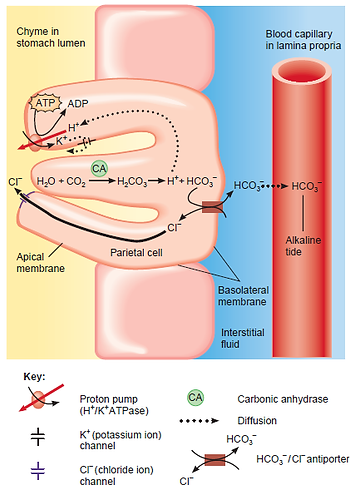
Ø Although parietal cells secrete hydrogen ions (H-) and chloride ions (Cl-) separately into the stomach lumen, the net effect is secretion of hydrochloric acid (HCl). Proton pumps powered by H-/K+ ATPases actively transport H_ into the lumen while bringing potassium ions (K_) into the cell.
Ø At the same time, Cl- and K+ diffuse out into the lumen through Cl- and K+ channels in the apical membrane. The enzyme carbonic anhydrase, which is especially plentiful in parietal cells, catalyzes the formation of carbonic acid (H2CO3) from water (H2O) and carbon dioxide (CO2). As carbonic acid dissociates, it provides a ready source of H_ for the proton pumps but also generates bicarbonate ions (HCO3-). As HCO3- builds up in the cytosol, it exits the parietal cell in exchange for Cl- via Cl-/HCO3- antiporters in the basolateral membrane (next to the lamina propria). HCO3- diffuses into nearby blood capillaries.
Ø This “alkaline tide” of bicarbonate ions entering the bloodstream after a meal may be large enough to elevate blood pH slightly and make urine more alkaline.
Ø HCl secretion by parietal cells can be stimulated by several sources: acetylcholine (ACh) released by parasympathetic neurons, gastrin secreted by G cells, and histamine, which is a paracrine substance released by mast cells in the nearby lamina propria. Acetylcholine and gastrin stimulate parietal cells to secrete more HCl in the presence of histamine.
Ø In other words, histamine acts synergistically, enhancing the effects of acetylcholine and gastrin. Receptors for all three substances are present in the plasma membrane of parietal cells. The histamine receptors on parietal cells are called H2 receptors; they mediate different responses than do the H1 receptors involved in allergic responses.



Comments